Aviation Noise Management and Research Post Covid-19: Part 3 Non Acoustic Factors

In the first two parts of this series of posts [1][2], we provided the context for our thoughts on the challenges facing the aviation industry in a post-COVID world whilst also looking at some parallels from the pandemic experience, and considerations for effective communication. In this third part, we will consider some of the challenges associated with the role of non-acoustic factors.

Again let us look at the pandemic experience which has led to ill health, impacts on wellbeing and on our quality of life (QoL). We had our freedom curtailed and social-distancing was introduced.

We have all reacted to the pandemic in different ways and with different levels of impact on our health, wellbeing and QoL. Our level of individual response to the impacts of the pandemic has been dependent on many variables such as differences in coping strategies and thresholds, personalities, sensitivities, family support, levels of housing, access to outdoor space, affluence, ethnicity, health inequalities, age, attitudes, mental health status, uncertainty of future, fear, rights for choice, need for trust in decision makers, fairness, belief system, vulnerabilities, levels of communication, and so on.


[3] Coronavirus: The world in lockdown in maps and charts (BBC)


[4] Coronavirus: 'Profound' mental health impact prompts calls for urgent research (BBC)


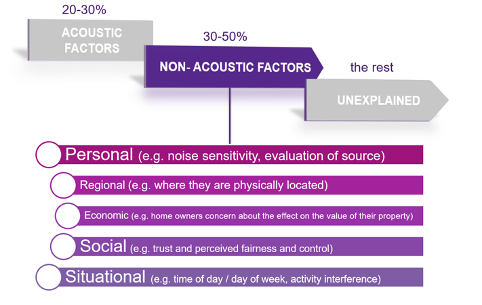
It is therefore not surprising that the same is true of our response to other stimuli, such as environmental or aviation noise. There are many factors that determine the level of response. In fact, research suggests that, at best, only a third of the annoyance response to aircraft noise relates to noise level alone.


What are Non Acoustic Factors?, © Anderson Acoustics Limited


Considering annoyance due to aircraft noise as a mere technical problem is only one side of addressing the noise challenge. The industry needs to provide effective noise management with workable solutions for all stakeholders and previously we suggested a new perspective was required. Non-acoustic factors are significant in determining the level of annoyance to aircraft noise events and must be given a raised priority in the design of noise management strategies. Pre-pandemic we focused in our work on the specific challenge of understanding the role of non-acoustic factors and how to integrate these within an airports noise management strategy [5].

Anderson Acoustics’ work previously identified these non-acoustic factors that could significantly affect an adverse response, based on an extensive review of available literature.


Prioritising Non Acoustic Factors for Aviation Noise Management Strategy, © Anderson Acoustics Limited


Treating aircraft noise annoyance around airports as a mere technical problem, involving exposure levels and dose–response functions is only one side of addressing the noise problem. The management process needs to acknowledge the role of non-acoustic factors including the differences in local perception and attitudes of residents. In fact a key challenge moving forward is to consider whether mitigating these Non Acoustic Factors can actually reduce impacts and improve health outcomes.

But have expectations now changed? ICCAN in their aviation noise lockdown survey [6] reported that:

“Of those surveyed, those bothered by aviation noise during the day and evening fell from 66% before lockdown to 28% during.

48% of respondents agreed that they do not mind if aviation noise goes back to what it was before lockdown, while 38% disagreed.

66% of respondents agreed that the environment should be given higher priority than supporting the recovery of the aviation industry, while only 15% disagreed.”

We agree with ICCAN that ‘tracking people’s views about the impact of noise on them will be crucial in building a sustainable recovery, where noise and its effects are at the heart of decisions about aviation’. So will there be a new baseline as a result of changes in expectations and attitiudes? This is a subject we will return to in a later part of this series, during which we will also look at some preliminary analysis of complaint behaviours.

On the topic of dose-response relationships, others have also been pausing for thought during this work hiatus and have considered the robustness and use of such relationships in environmental noise management [7]. We are sure the authors won’t mind us giving a taster of their work here. Their paper aims to remind researchers and policy-makers that in their view the dose-response relationships repeatedly being derived in standardised aircraft noise studies are poorly based both statistically and methodologically and they consider that that there should be some concern that policy and guidelines on health and environmental issues are currently based on ‘fairly flimsy’ evidence (I often wonder what important nuggets of understanding maybe concealed or hiding under these generalised curves). If this became more widely recognised within the research community then they suggest we might hope for a bigger push to be more open-minded and develop something new – rather than simply looking inwards and backwards all the time. They seem to agree with the need to take non-acoustic factors into account and that future work needs to change direction. They suggest that a new approach to understanding community attitudes to aircraft noise on a relative or comparative basis would also enable researchers and policy-makers to gain greater insight into the underlying influences on attitudes and tolerances (according to residents themselves) and their [realistic] preferences for future aircraft noise and any other associated consequences that are judged important by communities. They recognise there could be considerable insights to be gained from conducting limited scale qualitative research, not least because the lockdown has provided many residents with an opportunity for re-appraisal and to possibly start seeing things in different ways.

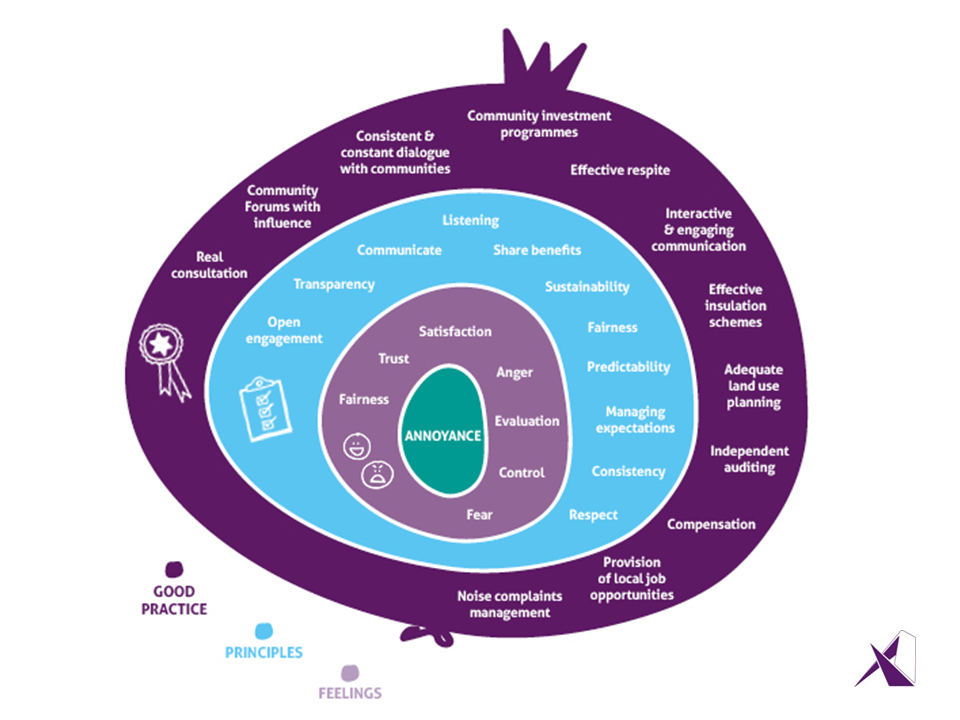
Pre-pandemic we introduced an ‘onion rings’ conceptual framework for providing practical guidance on how to integrate and address the non-acoustic factors within an airport’s noise management strategy  (presented in the figure below). This shows the adverse response in the centre, surrounded by core feelings that could lead to that response. The third ring presents principles that have been shown to affect or shape those feelings. The outer circle presents some of the initiatives and actions that, in consideration of those principles, could help to reduce the adverse response. We would note that the overriding principle for an effective non-acoustic strategy would be ‘open engagement’ to understand and address local community priorities – a topic we touched on in the previous ‘challenge’ in this article. Without this, airports and policy makers could find themselves addressing matters of little concern or value.

Non Acoustic Factors in Aviation Noise Annoyance, © Anderson Acoustics Limited


The EU project ANIMA [8] is also looking at the understanding of the role of non-acoustic factors in aviation noise annoyance with the project focused around how to alleviate the annoyance endured by communities through non-acoustical factors rather than by lowering noise itself. In the work the researchers regard communication as an intervention in its own right.

In summary therefore we reconfirm that there is an important challenge of improving our understanding the role of non-acoustic factors and how to integrate these effectively within an airports noise management strategy moving forward.


Authors: Nicole Porter and Robin Monaghan

© Anderson Acoustics Limited – reproduction and use with permission only


[1] Aviation Noise Management & Research: Reflections and Challenges in Light of the Pandemic

[2] Reflections and Challenges in Light of the Pandemic: Part 2 Enhancing and moving on the conversation

[3] Coronavirus: The world in lockdown in maps and charts (BBC)

[4] Coronavirus: ‘Profound’ mental health impact prompts calls for urgent research (BBC)

[5] D. Sanchez, J. Naumann, N. Porter and A. Knowles, “Current issues in aviation noise management: A non-acoustic factors perspective”, Proceedings from ICSV 22, Florence, Italy, 12-16 July 2015

[6] ICCAN survey on people’s experience of aviation noise during lockdown, October 8, 2020

[7] Ian Flindell, Paul Le Masurier, Harry Le Masurier, Resolving uncertainties in understanding community attitudes to aircraft noise, Applied Acoustics 178 (2021) 108032

[8] https://anima-project.eu/

All News

We'd love to hear from you

How can we add value to your project? Is there something we can help you with?

London: 0203 176 7909 Hove: 01273 696 887 Manchester: 07711 009 794 [email protected]

Connect with us

Institute of Acoustics Employee Ownership Association Living Wage Foundation Constructionline Builder's Profile Premium Acclaim SSiP UKAS ISO 9001: 2015    ISO 14001: 2015 Cyber Essentials Plus British Aviation Group UK Green Building Council Design in Mental Health Network Noise Network Plus