Aviation Noise Management & Research: Reflections and Challenges in Light of the Pandemic

FOREWORD

In early 2020, I was very busy in my consultant role as a technical advisor on aviation noise; its management, impacts and research. By contrast, in early 2021, I am now balancing home schooling, NHS vaccinating, and a myriad of other activities whilst trying to keep abreast of the future of the aviation industry. No one could have predicted how quickly our lives can change as a result of a worldwide pandemic.

In this series of posts, we will take the opportunity to reflect on lessons from this pandemic experience. We will identify some upcoming challenges and tasks that we recommend be considered whilst working towards the effective management of aviation noise as the industry recovers following the pandemic.

Please note that throughout this series of posts, we are in no means implying that risks to health, quality of life or wellbeing from environmental noise is anything like that in scale of a global pandemic, but we are just pausing for thought and contemplating how the lessons we are learning about societal impacts during this time could help teach us something about what we were working on pre-pandemic and give a little perspective to that work.

Nicole Porter


OPPORTUNITY KNOCKS BUT…

Pre-pandemic, aviation was growing, billions of pounds were being spent on reducing aviation noise at source and significant effort was being made in reducing overall noise levels. The ICAO Balanced Approach to aircraft noise management was pursued.


ICAO Balanced Approach, © Anderson Acoustics Ltd


Aircraft were getting quieter, operating procedures were improving, and better mitigation/insulation was being introduced. However, there appeared to be reduced trust between community and industry, annoyance was increasing, and there was perhaps a slavish obsession with the number of people inside a noise contour. However, in the last 5 years a change in airport behaviour had started to emerge. A research roadmap had been considered. It was recognised that noise management is at the core of planning; that noise had to be managed in a more sustainable and transparent way; and both acoustic and non-acoustic factors need to be taken into account.

Non-Acoustic Factors in Noise Annoyance, © Anderson Acoustics Ltd


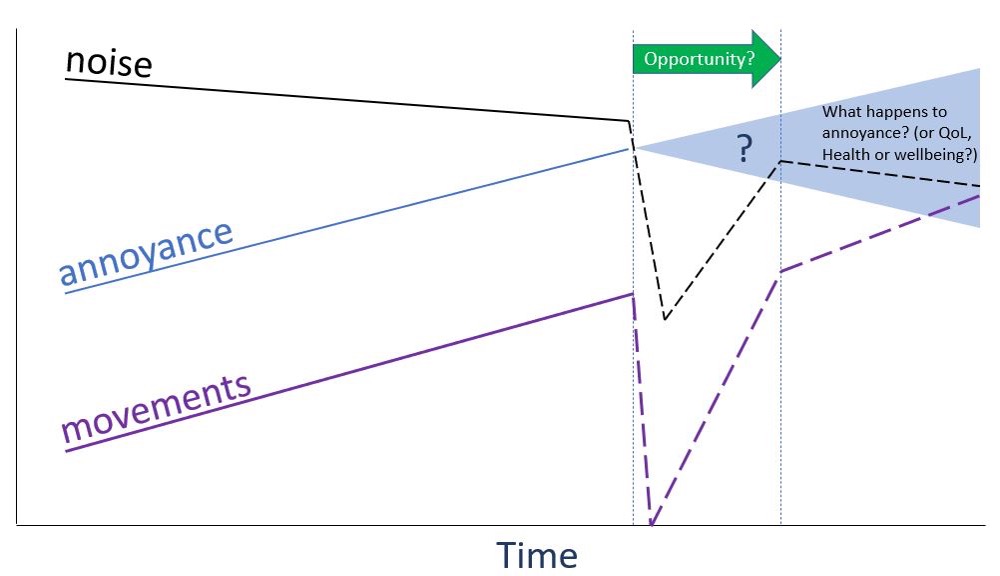
Post-pandemic, as aviation grows back, there should be an opportunity to reduce noise, build trust, leading to a more sustainable future for aviation – that opportunity starts now.

Aviation movements & noise have fallen during the pandemic. Does this mean there is a lower baseline? What does this mean for noise annoyance, health and quality of life?


But aviation is fighting for its life. Whilst there is a once in a life-time opportunity, there is the obvious barrier of funding. The industry has few funds, and the Government has more pressing priorities. Therein lies the reality of opportunity versus the inability to maximise it, the dichotomy of chance to research and lack of funds to implement.

We have been constantly reminded throughout this pandemic that Government decisions and actions are to be based on what the science says, i.e. the scientific evidence. The virus was new, so the scientific data was lacking. The decision makers were faced with a tough challenge: what is the strategy to move forward based on lacking, incomplete or insufficient scientific evidence? A conundrum. Hence the decision maker’s strategy had to evolve as more evidence became available. It is of course easy to criticise inaction or incorrect action. Hindsight is a wonderful thing. Regardless, we need to learn from events to increase our understanding and potentially help us take appropriate actions or decisions in future. These principles are being applied to the pandemic challenges but, on reflection, also need to be played out in developing our understanding of many complex topics, including effective aviation noise management.

So how do we set about progressing our understanding of aviation noise management and developing effective plans based on best available evidence as the aviation industry rebuilds? We also need to keep building our scientific evidence. And how do we maximise opportunity and challenge the financial barriers to evolving our understanding? We need some collective strategic thinking, with clearly defined goals and a plan for getting there. We need to ensure this is not a lost opportunity.


WHAT HAPPENS NEXT?

So, after the ‘dust has settled,’ what will this new landscape look like? Will people want to see the world more? Will wanderlust be accentuated? Or will business travel become a thing of the past, replaced by meeting in virtual worlds? Will the evidence of the impact of our pre-COVID existence on the environment drive society to choose more sustainable travel options? Change in the world is a certainty of life.

Disasters don’t have to be all negative. The positives or often hidden optimism in us hopefully can focus our thoughts to develop learning opportunities. Many are asking how can we come back better or recover well? The pandemic has demonstrated lessons learnt about working together for common good, focussed attention on finding effective solutions, working out who and what is important to a functioning society, shown that anyone maybe vulnerable, and that we are better off working together than against each other. As the aviation industry starts its road to recovery, what can we see as the challenges ahead for evolving effective aviation noise management and its research as we move forward?

Our Airports Team at Anderson Acoustics had been considering some of the key challenges to developing effective aviation noise management before the pandemic. These had been presented in a number of papers [1][2][3][4] and are summarised in the graphic below.

Key challenges for aviation noise management pre-pandemic, © Anderson Acoustics Ltd

In the coming weeks we will be presenting our thoughts on the challenges facing the aviation industry in a post-COVID world and this will include:

  • Enhancing and moving on the conversation
  • The importance of non-acoustic factors
  • Developing and evaluating effective interventions
  • The new baseline
  • Better understanding of future airspace design noise  impacts
  • Introducing an effective respite strategy
  • Reconsidering the research roadmap and setting new priorities
  • Sustainability and the role of interdependencies


Authors: Nicole Porter and Robin Monaghan

© Anderson Acoustics Limited – reproduction with permission only

_______________________________________________


[1] N. Porter, A. Knowles, “Key Issues in Aviation Noise Management”, IOA Bulletin, 2016

[2] D. Sanchez, B. Berry, A. Knowles, “The economic value of aircraft noise effects: a UK perspective”, Proceedings from 43rd International Congress on Noise Control Engineering, November 16-19, 2014. Melbourne. http://www.acoustics.asn.au/conference_proceedings/INTERNOISE2014/papers/p580.pdf

[3] D. Sanchez, J. Naumann, N. Porter and A. Knowles, “Current issues in aviation noise management: A non-acoustic factors perspective”, Proceedings from ICSV 22, Florence, Italy, 12-16 July 2015.

[4] N. Porter, A. Knowles, N. Fisher, D. Southgate, “The next generation of supplementary aviation noise metrics and their use in managing aviation noise”, Proceedings from 43rd International Congress on Noise Control Engineering, November 16-19, 2014. Melbourne. http://www.acoustics.asn.au/conference_proceedings/INTERNOISE2014/papers/p645.pdf

All News

We'd love to hear from you

How can we add value to your project? Is there something we can help you with?

London: 0203 176 7909 Hove: 01273 696 887 Manchester: 07711 009 794 [email protected]

Connect with us

Institute of Acoustics Employee Ownership Association Living Wage Foundation Constructionline Builder's Profile Premium Acclaim SSiP UKAS ISO 9001: 2015    ISO 14001: 2015 Cyber Essentials Plus British Aviation Group UK Green Building Council Design in Mental Health Network Noise Network Plus