Reflections and Challenges in Light of the Pandemic: Part 2 Enhancing and moving on the conversation

CHALLENGE: ENHANCING AND MOVING ON THE CONVERSATION

In the first part of this series of posts, we provided the context for our thoughts on the challenges facing the aviation industry in a post-COVID world whilst also looking at some parallels from the pandemic experience. In this part, we will consider some of the challenges associated with effective communication.

Before the pandemic, we identified the core principle of ‘open engagement’ as an essential part of a noise management strategy. We suggested that successful engagement requires effective means to describe and communicate noise exposure – in a meaningful and transparent way. The challenge is still to continue to develop ways of enhancing and moving on the conversation.

During this pandemic, we have been listening avidly to regular Government announcements, Downing Street briefings, and scientific research findings in an effort to increase our understanding of the pandemic and how it is being managed, to identify the risks to us as individuals, understand how we are expected to behave, and the consequences of our actions etc. Frequently, we have applied the ‘so what?’ question to what has been communicated and assess what all the information actually means to us, sitting at home with our families. We have in our heads specific questions and ask ourselves if these have been addressed in a way we have understood and whether we trust the answer.

This experience has led us, at Anderson Acoustics, to consider some lessons learnt about what may be important about effective communication and information sharing, which in our view has been applied with varying levels of success throughout the pandemic:

• the need for transparency
• dissemination of meaningful information in appropriate laypersons language using easy to understand and relevant descriptors
• developing a clear narrative with explanations of developing knowledge and, where appropriate, with clearly defined actions and meaningful targets
• translation of the science to answer the ‘so what?’ question
• clear evidence of opportunities to exchange and question the information (for robustness and validity)
• open, honest dialogue, with admission of mistakes and what has been learnt from them
• an appreciation of all stakeholders’ views together with real two-way communication
• a willingness of those in power to be challenged and face critics – no ivory towers
• a need for constructive engagement in moving forward
• evidence of openness to listen to new ideas, with a demonstrated willingness to try things and challenge failure

All these considerations can also translate in the effective communication of any complex topic, including aviation noise management. As acousticians, we should aim to provide all the relevant information in a simple and transparent way to facilitate the decision-making process and engagement with all stakeholders.


SO HOW CAN TWO-WAY COMMUNICATION BE ENHANCED?

In building more effective relationships between the industry and its stakeholders (including the community), the overall challenge is to build trust with open engagement and better communication. Effective communication is a two-way process, and, therefore, requires good listening, constructive conversation and mutual understanding.

Pandemic lessons clearly demonstrate that successful two-way communication requires:

1. Effective listening to identify and agree the key issues (of concern)/questions to be addressed
2. Selection of the most appropriate descriptors/metrics to help describe the noise situation/answer the questions
3. Effective presentation of these descriptors
4. Conveying the narrative with a clear story of how all the elements fit together, with clear messages
5. Allowing for feedback and continued conversation


1. UNDERSTANDING THE KEY ISSUES/QUESTIONS TO ADDRESS

During the pandemic, the nation as a whole has asked a plethora of questions with ultimately a burning desire to understand the risks to each of us and our loved ones. It has been up to Government, the scientists and health care professionals etc to listen, and breakdown the questions and issues of concern, and present the answers and plans with supporting information back to the nation.

As a parallel, at Anderson Acoustics, we have been involved in a fair amount of listening to aviation industry stakeholders and community views (many of which are not aligned) in an effort to understand and breakdown the issues of concern in relation of aviation noise management. We have experienced that effective listening requires focusing on what the other person is saying and not jumping to conclusions, and checking mutual understanding through clarifying questions. Listening often involves carefully understanding of the meaning of what is being said whilst remaining open to the possibility that alternative meanings are possible, depending on the individual.

Knowing the audience is also important so their needs are better understood and that appropriate language is used.

Understanding the key issues can be facilitated through open honest conversations. In aviation noise management, a number of ways have been set up to allow such conversations including complaint help desks [1] , community noise fora, engagement boards, stakeholder groups, consultations programmes, outreach programmes, other community relations activities. We accept that the success of these methods as effective means of two-way communication may have been judged at differing levels! In addition, research methods to identify and understand issues can be adopted such as social surveys and focus groups (for more in-depth insights). Whichever method is used to disentangle the issues and identify the key questions that need addressing, this should allow for an opportunity to reflect back and agree the issues.


2. CONSIDERING HOW TO EFFECTIVELY DESCRIBE THE NOISE – THE METRICS

Once the issues to be considered have been highlighted and agreed, the scenario needs to be described. Usually acousticians are responsible for describing the acoustic characteristics [2] and need to select of the most appropriate descriptors/metrics to help describe the noise situation of relevance. Let’s firstly touch on the way we describe noise exposure – the metrics.

Standard noise metrics are essentially based on long-term averages and frequently use noise contours to depict areas exposed to different measures of noise. Although these descriptors have particular roles to play in strategic noise impact and planning related assessment (often compared against specific criteria or used for historical trends), they do not necessarily adequately describe the actual community or individual experience and have been criticized by local community groups as being unhelpful, lacking transparency and sending the wrong message.

Example of noise contours – taken from DEFRA [3]


Supplementary noise descriptors have been developed that have been globally adopted. Often, the long-term average noise contours are presented with these supplementary data to give a more transparent and more complete picture of aircraft noise exposure. These metrics aim to better reflect what community experience in simpler language.

Previously, the authors have examined the limitations of traditional noise contours for describing noise exposure and considered a more targeted contour based on shorter-term noise measures . The following figure summarises what we mean by the terms “standard” and “supplementary” metrics.

One project Anderson Acoustics were involved in was the analysis of noise measurements from Heathrow DOKEN westerly departures precision navigation trials which ran from December 2013 to June 2014. During this time period all Midhurst westerly departures followed one of four temporary precision routes according to a pre-arranged schedule. Each DOKEN route overflew different sections of the residential areas under the previous dispersed westerly Midhurst departures routes. Our analysis work showed that using supplementary metrics helped to describe the noise change.

Previously, we promoted the principle that noise descriptors should be tailored towards the specific questions that are being addressed and many have heard us say the words ‘the metrics need to be fit for purpose’. So the questions being considered and who is asking them – the purpose – needs to be agreed. Then one needs to consider how best to describe the noise (the fit) to meet this purpose. It is then important to then use these descriptions or metrics to present the information in a way that the objective data and its validity can be agreed, and then used to aid understanding of trends, optioneering and decision making etc. Adopting this approach will be invaluable in understanding how the noise environment has changed as a result of the pandemic.


3. CONSIDERING HOW TO EFFECTIVELY PRESENT THE INFORMATION

It is not just metrics used in the conversation that are important, but the tools and techniques used to communicate noise and its potential impacts which can be used to describe prevailing conditions, future scenarios and meaningfully demonstrate change. Let us consider how to present the metrics and other information for indeed a picture is worth a thousand words. But one must be careful which words we actually want the picture to tell as being able to take the messages the information gives us and show them in a picture is a powerful tool and we must treat it with respect or misinterpretation can quickly become an issue.

Technological advances and increased capabilities in applying these metrics have led to the development of new ways to present information in a more meaningful and tailored manner. It has been possible to present data at very detailed levels for a number of years now (grid level, postcode, property points) but the next challenge is how to manage these huge datasets whilst keeping the story clear and concise.

Let us look at the pandemic data. Next is a screenshot of John Hopkins resource dashboard on Coronavirus cases . This gives some great information including a geographical snapshot of cumulative cases, from which to develop an understanding of the story. Such data has been helpful to those tracking the spread of coronavirus around the world, to track trends, and presumably is able to look at the changes due to management decisions such as different interventions etc, or the advent of different variants.


John Hopkins Coronavirus Resource Centre


So the challenge in aviation noise management is to also chose the best tools to present the datasets to help understand both existing or predicted scenarios, and show change. At Anderson Acoustics, we have developed our own tools combining information and relationship-based databases to provide on the fly data representation for large specific geographical datasets.

One of our colleagues has been involved in mapping COVID-19 using Maploom . He suggests that this approach is adaptable to any spatial dataset or global issue where comparisons between and within countries are needed, or where you need to track the evolution of trends over time. Having a consistent way to view the data at different scales would allow much more powerful visualisation and analysis between areas.

At Anderson Acoustics, we have been adopting these visualisation techniques for aviation noise.

Our next challenge is to therefore to evolve these visualisation tools and techniques to present and improve our understanding the situation and to assist in noise management decisions moving forward.


4. CONSIDERING THE PRESENTATION OF THE NARRATIVE AND ITS CONTEXT

How do we best convey the story, present the narrative or answer the questions describing how all the information fits together (this includes the ‘so what?’ test)? Targeted noise descriptors and meaningful ways of presenting them, together with information on other factors, such as health, costs and agreed policy objectives, can be drawn together to provide information about the bigger picture with ‘balanced scorecard’ for use in effective aviation noise decision-making (see generic example below ).

Including additional information such as health effects and monetary information can be help to create a comprehensive picture of the situation as well as where to focus strategies (e.g. noise insulation) and facilitate decision-making.

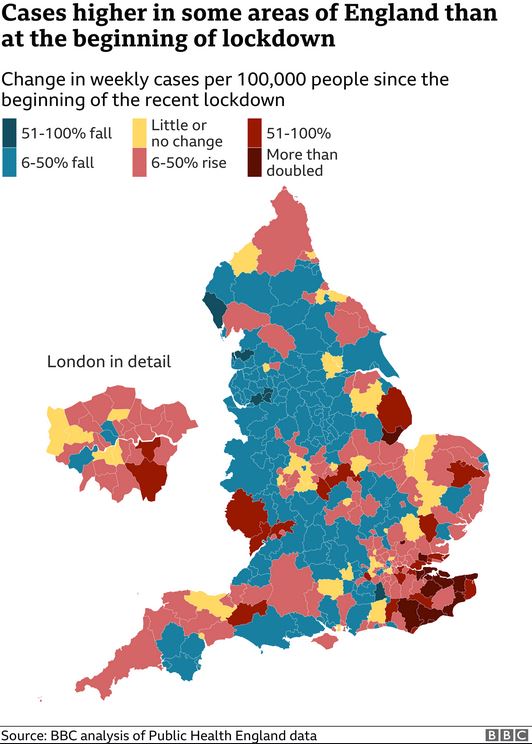
But the narrative clearly also needs to be explained together with clear messages – tell the reader what the figure or chart means in the ‘story’ so the reader knows about the ‘so what’. An example is given next from the pandemic . It explains the key message from the data and presents the change metrics by geographical location. This example uses the measurement and monitoring of the COVID-19 statistics (assisted by Track and Trace) on a geographical basis. It helps to show changes and trends and pinpoint issues (for example being used to identify the developing dominance of the so called “Kent variant”). For this, it needed the right metrics, accurate data, understanding of variance and significance of data trends and change, and meaningful ways of showing these. Furthermore, it needed to present a key take-away message – in this case this was ‘cases are still rising in London and much of the South East’.

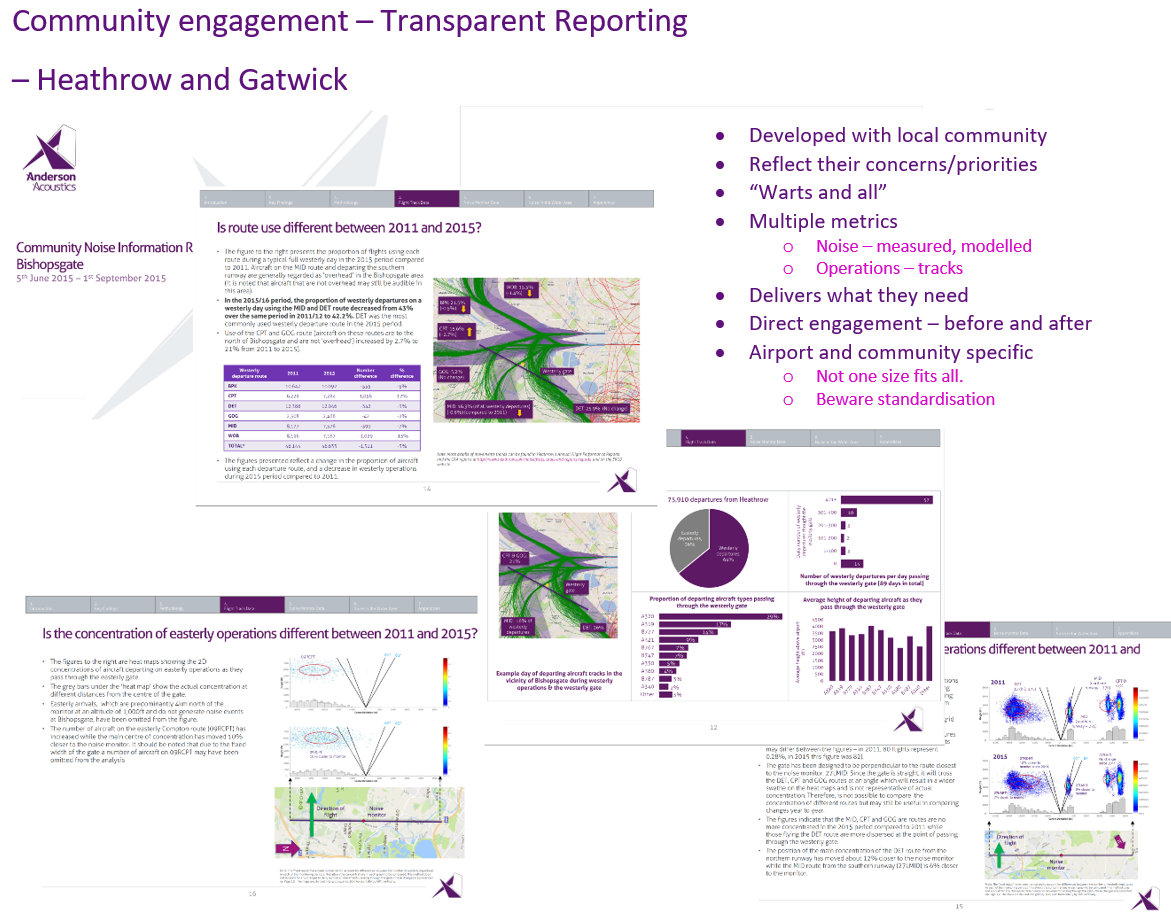
Through our work with various airports, Anderson Acoustics have welcomed the opportunity to develop approaches to community noise reporting and we advocate (and would like to be involved with) developing a best practice approach. We have learnt much from developing community reports for three of the London airports, which followed an approach based on addressing key questions that the community were asking, adopting the most suitable metrics, presenting the information both graphically and using visually mapping tools, with explanatory text to give the key take-away messages and tell ‘the story’. We worked with both the airports and community on refining these reports, and welcomed the feedback during the development process. Some of our lessons learnt are included below.

Of course, having a story and then telling it can make use of a range of different forums and electronic media. Drawing from the pandemic experience again, we have seen live announcements from Government, media messaging and campaigns which have implement visualisation tools, live drawings or educational videos – remember the take-away messaging around ‘handwashing to happy birthday’, ‘hands/face/space’. There was a need to use a variety of media to reach different audiences using appropriately levelled language and terminology.

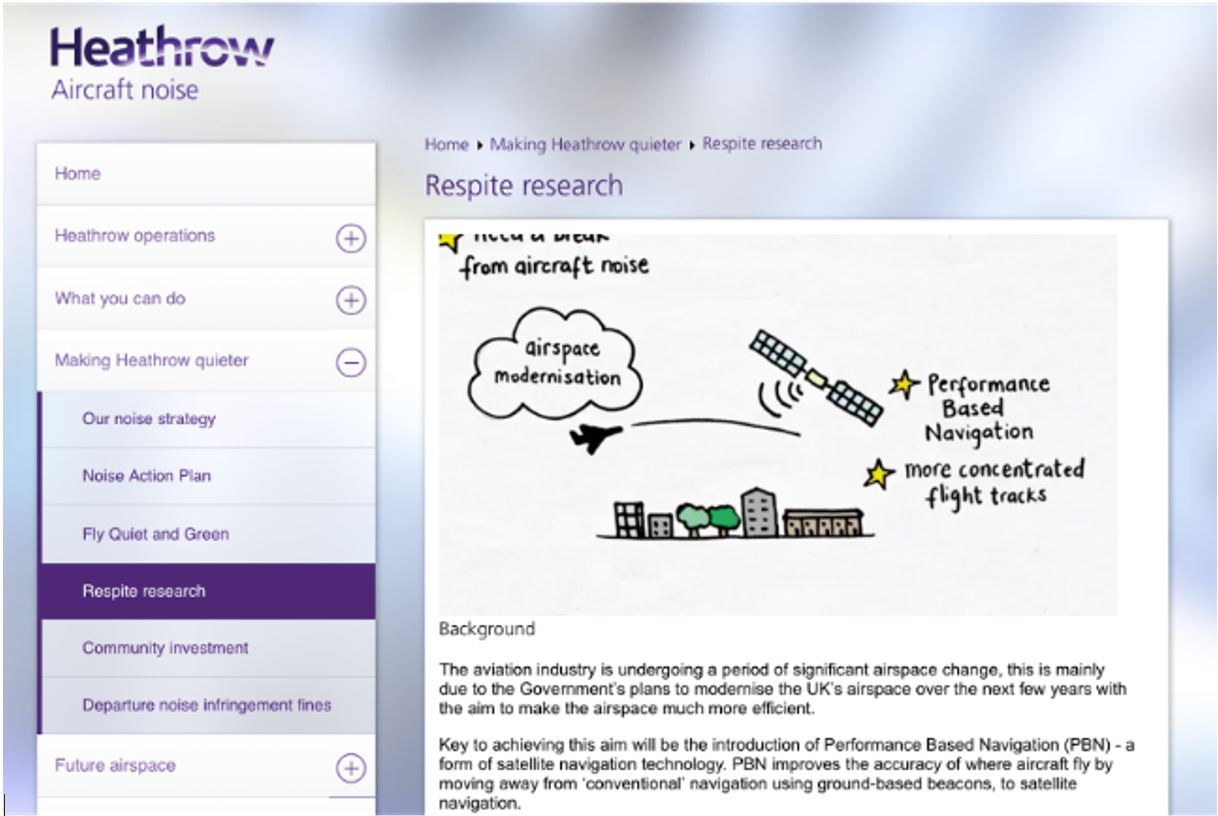
One approach that we at Anderson Acoustics have adopted was to tell the story of respite from aviation noise research as an animation, for which we received encouraging feedback.

Moving forward, the challenge is to test and adopt the best combination of media and messaging to reach the intended audience to effectively communicate the key messages, issues, or answers to key questions. Let’s encourage and support innovative approaches to get messages across!


5. ALLOWING FOR FEEDBACK AND CONTINUED CONVERSATION

At the beginning of this part of this article, we touched on the general lessons learnt from the pandemic experience for effective communications, which included a few items focussed about the need for allowing feedback and continued conversation. This included –

• clear evidence of opportunities to exchange and question the information (for robustness and validity), together with
• open, honest dialogue, with admission of mistakes and what has been learnt from them
• willingness of those in power to be challenged and face critics – no ivory towers
• a need for constructive engagement in moving forward
• evidence of openness to listen to new ideas, with a demonstrated willingness to try things and challenge failure

It is evident that this is a vital part of the open engagement process, which is often overlooked and should be built-in to any two-way communication activity.


CONCLUDING REMARKS

This aim of this series is to share and provoke thoughts on the challenges in aviation noise management facing the industry in a post-COVID world whilst also looking at some parallels from the pandemic experience. Others have also been pausing for thought with encouraging work on effective communication.

Interestingly ICCAN, who includes in its remits an aim of improving public confidence and trust in the management of aviation noise, has recently completed a survey on community engagement to try to better understand existing methods of engagement used by airports with their local communities, and their effectiveness . There were several areas where they wanted to see improvements. These were particularly around understanding the impact of noise from a community perspective, developing a genuine two-way dialogue, improving the quality of information provided by making it less technical, and being more honest when discussing the negative impacts. Many of these improvements are in line with the principles we have touched on in this section.

Furthermore, the ANIMA research programme (Aviation Noise Impact Management through novel Approaches) is a comprehensive research programme and has held a series of interesting workshops and podcasts. They are also looking at effective communication and have included some work examining how much the layperson actually understands some of the charts and figures that have been used in the past to inform the public.

This thought leadership piece is one of a series presenting our thoughts on the challenges facing the aviation industry in a post-COVID world and this will include:

  • Enhancing and moving on the conversation
  • The importance of non-acoustic factors
  • Developing and evaluating effective interventions
  • The new baseline
  • Better understanding of future airspace design noise  impacts
  • Introducing an effective respite strategy
  • Reconsidering the research roadmap and setting new priorities
  • Sustainability and the role of interdependencies


This first part of this series can be found here.

The next part of this series will focus on the development of new approaches in effective aviation noise management through recognising the importance of non-acoustic factors.

Authors: Nicole Porter and Robin Monaghan

© Anderson Acoustics Limited – reproduction with permission only

_______________________________________________


[1] In a later part of this series we will be looking at the role of complaint data in adding to our understanding of key community issues around noise, and look at how this data has painted a picture around the potential shifts in behaviour as a result of impacts of the pandemic.

[2] Note that important role of the non-acoustic factors which should also be taken into account which is the subject of a later part of this series.

[3] https://www.gatwickairport.com/globalassets/business–community/new-sub-category-landing-pages/aircraft-noise–airspace/fpt-reports/gal-end-noise-action-plan-annex-lr.pdf

[5] http://www.acoustics.asn.au/conference_proceedings/INTERNOISE2014/papers/p645.pdf

[5] https://www.ioa.org.uk/sites/default/files/Acoustics%20Bulletin%20March-April%202016.pdf

[6] https://coronavirus.jhu.edu/map.html

[7] https://www.rgs.org/geography/geovisualisation/mapping-covid-19/

[8] https://www.acoustics.asn.au/conference_proceedings/INTERNOISE2014/papers/p645.pdf

[9] From the BBC

[10] https://iccan.gov.uk/wp-content/uploads/2020_12_02_ICCAN_Best_Practice_Engagement.pdf

[11] https://anima-project.eu/#:~:text=Aviation%20Noise%20Impact%20Management%20through,noise%20around%20Europe’s%20major%20airports.


All News

We'd love to hear from you

How can we add value to your project? Is there something we can help you with?

London: 0203 176 7909 Hove: 01273 696 887 Manchester: 07711 009 794 [email protected]

Connect with us

Institute of Acoustics Employee Ownership Association Living Wage Foundation Constructionline Builder's Profile Premium Acclaim SSiP UKAS ISO 9001: 2015    ISO 14001: 2015 Cyber Essentials Plus British Aviation Group UK Green Building Council Design in Mental Health Network Noise Network Plus