
We don’t just collect dust samples. We help clients understand and manage dust nuisance risk.
The Environmental Compliance Challenge
On many construction, earthworks and infrastructure schemes, deposited dust can be a significant nuisance pathway. Settling dust causes visible soiling of nearby properties, vehicles and outdoor surfaces, and it is this visible soiling that often drives complaints and stakeholder concern. It is the most common reason clients commission frisbee gauge monitoring in the first place: to demonstrate, with defensible data, that deposition is being kept within agreed limits.
Dust deposition monitoring provides defensible evidence when complaints arise, helps demonstrate compliance with planning conditions, and allows project teams to identify emerging dust issues before they become regulatory or stakeholder problems.
Managing dust emissions across a complex infrastructure project is often more than just environmental responsibility. It can be a client specification or a permit condition. Your project may have limits on dust deposition rates (often 200 mg/m²/day). Failing to demonstrate compliance isn’t just an environmental issue; it can lead to project delays, fines, and stakeholder friction.
But setting up a dust monitoring network across multiple locations, collecting samples monthly, coordinating lab analysis, and producing compliant reports, that’s a significant operational burden on top of your existing construction or environmental management role.
Our monitoring programmes are designed around recognised industry methodologies and quality assurance procedures to ensure reliable and defensible results.

We handle the Monitoring. You own the Compliance.
We provide, deploy and manage your dust deposition monitoring network across all project phases. Monthly sample collection, lab coordination, and detailed compliance reports, all handled by our team so you have defensible, auditable documentation ready when regulators ask.
Some local authorities, including the London Borough of Hammersmith & Fulham, now require dust deposition monitoring as part of construction and demolition Air Quality Dust Management Plans, with boundary monitors installed before works commence and results assessed against site dust action levels. Our dust deposition monitoring service provides a simple, robust way to demonstrate control of dust soiling risk at sensitive receptors and support planning condition discharge, construction phase compliance and community assurance.
What We handle So You Don’t Have To
- Site coordination: Work with your team to identify optimal monitoring locations that meet regulatory requirements and capture representative dust deposition;
- Equipment deployment: Install and secure gauges across your project footprint and manage them throughout all project phases;
- Monthly sample collection: Predictable monthly visits to each location. No surprises. Professional chain-of-custody documentation;
- Lab liaison: Coordinate with certified analytical laboratories and dispatch the bottles. We chase results; you don’t have to;
- Compliance verification: Each month, we tell you whether the dust deposition was above or below the criteria. No ambiguity;
- Monthly reports: Location maps, data tables, compliance status, and trend analysis. Ready to submit to regulators or present to stakeholders;
- Equipment maintenance: Gauges fail, get damaged, or move. We manage replacements and keep the monitoring going;
- Regulatory communication: If a location exceeds limits, we identify it and help you understand what happened and what to do about it.
Where Dust Deposition Monitoring Is Used
Dust deposition monitoring is commonly used across:
- Construction sites
- Demolition projects
- Earthworks and bulk excavation
- Remediation schemes
- Quarries and mineral operations
- Waste and recycling facilities
- Ports and material handling terminals
- Asphalt, concrete and aggregate plants
- Industrial sites
- Landfills
- Rail and highway infrastructure projects
- Battery and gigafactory construction
- Logistics developments with large areas of exposed ground

When Are Frisbee Gauges The Right Choice?
Frisbee gauges are particularly effective where the primary concern is dust soiling and nuisance rather than airborne particulate exposure. They provide a cumulative measure of deposited dust over time and are widely used to assess the effectiveness of dust management measures at construction, industrial and infrastructure sites.

We also provide continuous PM10 monitoring with remote access by web portal for projects that need to assess airborne particulate exposure, so we can support you with the right monitoring approach for your site, or both together.
Not sure whether you need dust depositon monitoring or PM10 monitoring?
We can advise on the most appropriate monitoring strategy based on your planning conditions, permit requirements, receptor sensitivity and project activities.
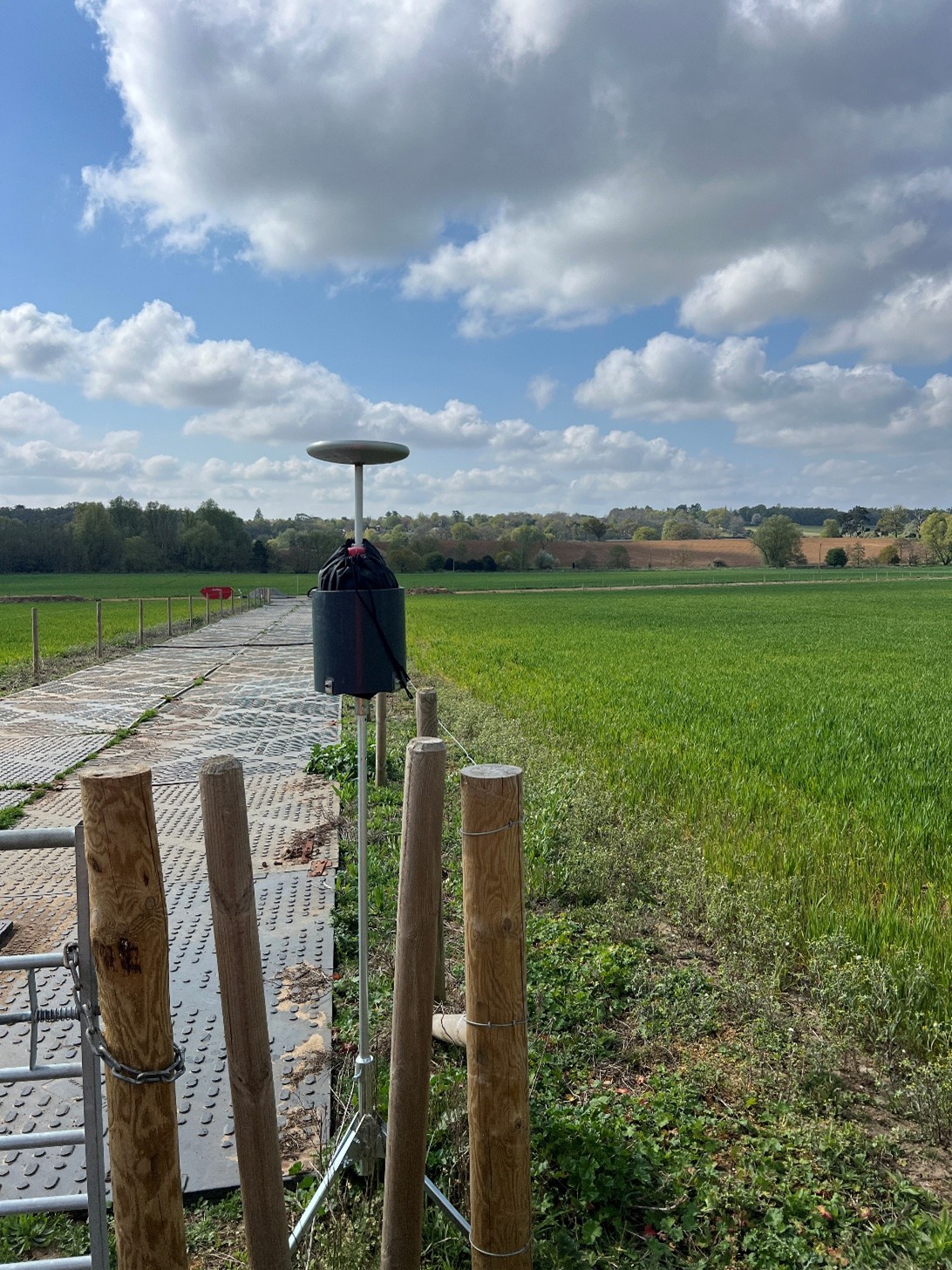
Note: Dust deposition gauge installed at a sensitive receptor location adjacent to an active construction project and demonstrate good practice through covering the trackway to the site to minimise dust emission.
How This Works In Practice
Initial Setup – We meet with your team to understand your permit conditions, identify regulatory limits, map sensitive receptors, and determine optimal monitoring locations. We integrate with your environmental management plan.
Ongoing Operations – Monthly visits on a predictable schedule. We collect samples, deploy fresh gauges, check equipment condition, and document everything. We send the samples to the lab. You get a monthly report within 2 weeks of collection.
Reporting & Compliance – Each month you receive: location-specific results, regulatory limit comparison, exceedance flags, and trend analysis. The data is yours to use for project communications, regulator submissions, or operational adjustments.
Adaptive Management – If data shows unexpected patterns or exceedances, we help you interpret results and recommend adjustments to dust control measures. You’re managing with real data, not guessing.
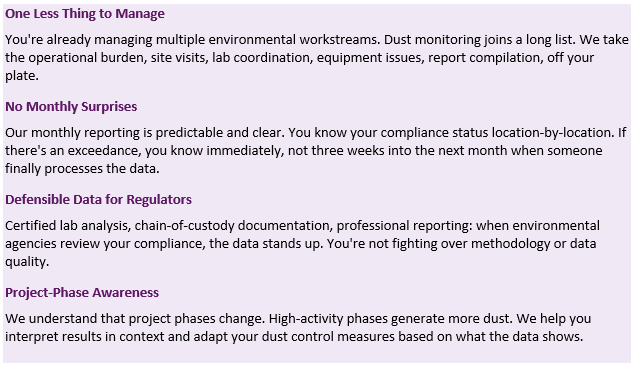
Why Construction And Environmental Managers Choose Us
What Happens If Dust Deposition Exceeds Limits?
If a location exceeds its dust deposition limit, our team:
- Reviews site activities during the monitoring period
- Assesses local meteorological conditions
- Identifies potential causes
- Reviews dust control effectiveness
- Provides practical mitigation recommendations
- Documents findings for regulators and stakeholders
This turns monitoring from a commodity service into consultancy.
What you’ll receive each month
✓ Laboratory-certified dust deposition results;
✓ Compliance assessment against project criteria;
✓ Site-specific monitoring location plans showing the relationship between receptors, monitoring locations and the project works;
✓ Long-term trend analysis allowing project teams to understand changes in dust deposition throughout the construction programme;
✓ Clear identification of any exceedances against project criteria, supported by expert interpretation and recommendations where required;
✓ PDF report suitable for regulator submission
From single-location monitoring to large-scale infrastructure projects with multiple receptor locations, we provide a fully managed dust deposition monitoring service backed by laboratory analysis and regulator-ready reporting.
 Illustrative example of the type of reporting provided. Actual report layouts may vary depending on project requirements
Monitoring Standards
✓ Continuous Collection – Passive dust gauges deployed continuously during project phases to your required durations;
✓ Monthly Sampling – Sample collection and replacement on an agreed monthly schedule;
✓ Certified Lab Analysis – Third-party analytical laboratory with chain-of-custody procedures;
✓ Professional Reporting – Monthly compliance reports with regulatory limit comparison;
✓ Quality Assurance – Equipment maintenance and quality control throughout project
Our monitoring methodology is built on established, defensible technical standards:
- Dust deposition measured in mg/m²/day
- Frisbee gauge methodology
- Monthly laboratory analysis
- Chain-of-custody procedures
- Quality assurance checks
- Monitoring strategy based on receptor risk assessment
Let’s Talk About Your Dust Monitoring Programme
Whether you require a single monitoring location, a multi-site gauge network or a large-scale infrastructure monitoring programme, we can design, deploy and manage a dust deposition monitoring solution tailored to your project.
Head on over to our Construction and Air Quality pages for more information.


