
Our AirAssure monitors can provide useful evidence about indoor air quality and limited aspects of the indoor environment. The readings are most useful when they are interpreted alongside occupancy, ventilation, activities and the way the building is operated.
What the monitors can contribute
The phrase building health is useful shorthand, but an AirAssure survey is not a complete assessment of whether a building is healthy. Indoor conditions vary with occupancy, ventilation, weather, maintenance, cleaning, fit-out materials and the way the space is used. A single reading can therefore miss a recurring problem or identify an event without explaining its cause.
The AirAssure 8144-6 monitors continuously measure carbon dioxide, particulate matter, total volatile organic compounds, carbon monoxide, nitrogen dioxide, sulphur dioxide, ozone, temperature, relative humidity and barometric pressure. Data can be reviewed remotely through TSI Link. This can provide a useful screening record of how conditions change through the day, but the results still need to be interpreted in the context of the building and the limitations of the sensors.

What a building health check should answer
A useful check should answer practical questions. Do carbon dioxide patterns suggest that ventilation is keeping pace with occupancy? Are there periods when particulate or VOC concentrations rise? Do these events coincide with cleaning, printing, cooking, deliveries or changes in ventilation? Are temperature and humidity likely to be contributing to reported discomfort? Do apparently similar rooms perform differently? Do concentrations fall when a space is unoccupied?
These questions shift the focus from a single pass or fail result to performance in use. This is consistent with the direction of BS 40102-1:2023, which addresses the measurement, evaluation and improvement of health, wellbeing and indoor environmental quality in occupied non-domestic buildings. It is also consistent with CIBSE TM40, which emphasises operational performance, post-occupancy evaluation and monitoring rather than design intent alone.
What the AirAssure parameters can tell us

A practical service using two monitors
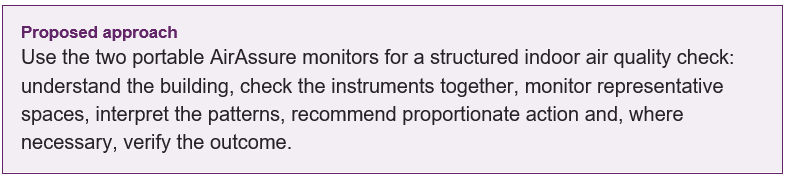
Two instruments will not describe every part of a large building at once, but they allow a useful comparative approach. The monitors should first be co-located to check their clocks, data capture and broad agreement. They can then be used in a space of concern and a suitable comparator, in two similar spaces, or moved through representative zones in stages.
- Understand the building. Review complaints, occupancy, ventilation strategy, BMS trends, maintenance history, cleaning arrangements and any recent fit-out or refurbishment. Undertake a walkthrough before deciding where the monitors should go.
- Design a representative campaign. Select occupied spaces that reflect the building’s uses and ventilation zones. A two-week deployment is often a reasonable starting point where normal occupancy is expected, as it can capture weekday cycles, unoccupied periods and a weekend. Seasonal repetition may be necessary where natural ventilation or plant operation changes materially.
- Check placement and context. Position each monitor in a representative occupied location, away from doors, open windows, supply diffusers and people’s immediate breathing zone. Record occupancy, window and door status, plant operating times and notable activities. Data without context can identify a pattern but rarely explains it.
- Interrogate the time series. Review diurnal profiles, occupied and unoccupied periods, peaks, persistence, recovery and differences between spaces. Avoid reducing a variable dataset to one average or one traffic-light score.
- Investigate the cause. Use targeted follow-up measurements where required. These may include ventilation flow measurements, smoke visualisation, pressure checks, inspection of filtration and controls, or laboratory VOC sampling. Any outdoor comparison would require a separate weather-protected monitor suitable for outdoor use.
- Verify the improvement. Repeat monitoring after changes to ventilation, controls, maintenance or occupant guidance. This closes the loop and shows whether the intervention improved performance in use.
Where the checks could add value
The approach could support post-occupancy evaluation, seasonal checks, refurbishment planning, handover and aftercare, ventilation reviews, investigation of occupant complaints and verification following changes to building services. Schools, offices, healthcare settings, hotels and public buildings present different occupancy patterns. The survey design and interpretation would need to reflect those differences.
The monitors could also support wider frameworks such as WELL or BS 40102-1, provided we are clear about the boundary. AirAssure data may contribute evidence about air quality and limited aspects of thermal conditions. It does not by itself constitute an assessment of overall indoor environmental quality, which also includes matters such as acoustic conditions, lighting, thermal comfort and occupant experience.
The limits matter
The limitations need to be stated clearly. The monitors do not detect asbestos fibres, radon, mould spores, bacteria, allergens or ultrafine particles. The 8144-6 does not measure formaldehyde. TVOC is not a substitute for identifying individual chemicals. CO2 is not a complete ventilation assessment, particularly where occupancy is uncertain or air cleaning is used. Temperature and humidity are not a complete thermal comfort study. The carbon monoxide channel must not replace a compliant life-safety alarm.
The gas and particle sensors are suitable for indicative monitoring and pattern recognition, but significant findings may need to be confirmed using reference instruments or accredited laboratory methods. Sensor drift, cross-sensitivity, humidity effects, placement and local activities all need to be considered. A monitor beside an open window, supply diffuser or someone’s desk may produce data that are real but not representative.
There is also a risk in presenting a building health score without explaining uncertainty. A simple score can help communication, but it should sit above transparent data-quality checks, clear criteria and professional interpretation. It should never conceal persistent problems within a reassuring building-wide average.
From a check to an improvement plan
The report should provide a concise explanation of what appears to be happening, how confident we are, what needs further investigation and what action is proportionate. That may mean changing plant operating times, rebalancing ventilation, replacing filters, controlling a local source, revising cleaning products, improving window-management guidance or undertaking more specific sampling. Sometimes the result will be that a reported problem was not evident during the monitored conditions. That is still useful, provided the limits of the evidence are clear.
This gives a sensible progression for the service: screening, interpretation, targeted investigation and verification. The value comes from connecting the indoor air quality data with the building, its services and the way it is occupied.

Conclusion
Our AirAssure monitors can provide useful screening data on indoor air quality and limited aspects of the indoor environment. A continuous record can identify patterns that a one-off visit may miss and help move an investigation from a general concern to a more focused next step. Without occupancy and operational context, however, the same data may be difficult to interpret.
The sensible approach is therefore to use the monitors as part of a proportionate assessment of performance in use, supported by an understanding of the building services, transparent limitations and clear recommendations. It should be presented as an indoor air quality and building-performance check, not as certification that a building is healthy.
Sources and further reading
TSI AirAssure 8144-6 product information and measured parameters
BSI, BS 40102-1:2023 overview
CIBSE TM40: Health and wellbeing in building services
HSE guidance on using CO2 monitors to assess workplace ventilation
WELL Building Standard, air quality monitoring and feedback


