
Executive summary
ICBEN 2026 was a broad public-health conference rather than a single-topic aircraft-noise event. Its programme covered transport noise from aircraft, road and rail sources, but also extended across soundscape, speech communication, hearing and listening environments, noise-induced hearing loss, environmental health, cognitive effects, mental health, annoyance, sleep, vulnerable groups, policy, health-risk assessment and methods for social and socio-acoustic surveys.
This news item therefore begins with the breadth of the conference, then focuses on the areas most relevant to the work of our aviation sector work: aircraft noise, airspace change, human response, non-acoustic factors, community engagement, fairness and the interpretation of metrics in policy decisions.
A strong message across the conference was that noise assessment is becoming more explicitly human-centred. Acoustic indicators remain essential, but they are tools rather than complete explanations of response. They describe exposure and support comparison, but they do not by themselves explain annoyance, sleep disturbance, trust, (un)acceptability or fairness. Non-acoustic factors are therefore not peripheral: they are part of the mechanism through which communities experience and judge noise.
The non-acoustic factors symposium was particularly important. It showed that NAFs are becoming a more formalised field of practice, with emerging international standards, work on consistent terminology, and discussion of how factors such as trust, control, expectations, attitudes, noise sensitivity, coping capacity and fairness should be collected, interpreted and used in assessment and policy.
Conference scope – a broad programme on noise as a public health problem
The conference programme demonstrated the breadth of current international noise research. Sessions ranged from aircraft noise, transport-noise modelling and exposure-response relationships to soundscape, restorative environments, hearing and communication, speech intelligibility, noise-induced hearing loss, classroom and workplace listening environments, mental health, annoyance, sleep, and methods for analysing survey data.
This breadth matters. It places aircraft-noise assessment within a wider public-health context and highlights that communities experience sound and noise through many interacting pathways: disturbance, sleep, communication, activity interference, stress, annoyance, coping, perceived control, trust, context and wider quality of life. The programme therefore reinforced that environmental noise is not only a technical exposure problem; it is also a human, social and policy problem.
The conference also showed that different research traditions are converging. Acoustic modelling, epidemiology, public health, soundscape, social survey research, community engagement and spatial planning are increasingly addressing overlapping questions about how sound environments affect health and wellbeing, and how this evidence should inform policy.
Our focus within the conference
Within the wider programme, our main professional interests were the sessions most relevant to airport noise, airspace change and community response. These included night noise and sleep, event-based metrics, annoyance, quality of life, social survey methods, disability weights and burden of disease, non-acoustic factors, and the design of policy-relevant indicators.
The central question running through these sessions was how to move from measuring noise to understanding response. Noise measurement is one tool we use to understand human response to a noise source. It can help explain response, but it cannot do all of that work alone. Its limitations need to be recognised explicitly, particularly where decisions affect the distribution of noise between communities.
This is where non-acoustic factors become critical. They help explain why people exposed to similar acoustic conditions may respond differently, and why a technically favourable option may still be perceived as unfair, or less socially unacceptable. In our own work, perceived fairness is a particularly important NAF because communities around airports are often not only asking how much noise there will be, but who receives it, who benefits, who has control, and whether the process is trustworthy.
Cross-cutting themes relevant to aircraft-noise policy
Several cross-cutting themes were especially relevant to aviation noise policy and practice. They were not confined to a single session: they appeared repeatedly across sleep research, annoyance and quality-of-life papers, survey methods, non-acoustic factors, burden-of-disease work, and discussions about policy translation.
- A broad public-health framing: The programme placed aircraft noise within a wider public-health field that also included road and rail noise, soundscape, speech communication, hearing and listening environments, cognitive effects, mental health, vulnerable groups, health-risk assessment and policy. This matters because aircraft-noise work can draw lessons from wider environmental-noise research rather than treating aviation as a completely separate problem.
- Metrics as decision-support tools, not full explanations: Acoustic indicators remain essential for describing exposure, comparing options and providing accountability. However, many sessions reinforced that measured or modelled sound levels cannot, by themselves, explain annoyance, sleep disturbance, acceptability, fairness or trust. The important question is therefore not whether to use metrics, but how to use them with an honest account of their limits.
- Event patterns and time of exposure: Night-noise and sleep sessions showed the value of looking beyond long-term averages. Average indicators such as LAeq or Lnight remain useful, but event-based measures, number-above metrics, maximum levels, timing of events and awakening-related metrics can be more meaningful where the policy issue concerns night flights, early-morning operations, repeated overflight or respite.
- Human response is multi-pathway: Across the conference, annoyance, sleep disturbance and health outcomes were presented as responses shaped by several pathways: activity disturbance, communication interference, sleep disruption, stress, cognitive and emotional appraisal, coping, expectations and perceived control. This supports a more human-centred view of noise assessment, where exposure is the starting point rather than the whole explanation.
- Non-acoustic factors as part of the evidence base: The NAF symposium made clear that factors such as trust, attitudes to the source, noise sensitivity, coping capacity, perceived control, expectations and perceived fairness are not simply “soft” add-ons. They can influence how people experience and respond to noise, may help explain differences between communities exposed to similar sound levels, and are increasingly being formalised through standards work and harmonised data-collection guidance.
- Fairness and social (un)acceptability: For airspace change, the conference themes point towards a broader interpretation of impact. Communities may not only be comparing decibel levels; they may be judging whether a proposal is more or less socially unacceptable, whether burdens and benefits are fairly distributed, whether respite is meaningful, whether newly overflown areas are treated appropriately, and whether the process is transparent and trustworthy.
- Methods, comparability and survey design: The ISAR archive, noise-sensitivity measurement work and NAF standards discussions all emphasised the need for consistent definitions, transparent reporting and comparable survey instruments. This is particularly important for future socio-acoustic surveys, where results need to be robust enough for policy use while still capturing context and lived experience.
- Health-risk assessment and communication: The disability-weight and burden-of-disease sessions showed that estimates of public-health burden depend heavily on methodological assumptions. Lower updated disability weights for annoyance and sleep disturbance do not mean noise is unimportant, but they do create a communication challenge. Reports need to explain what DALYs capture, what they omit, and how uncertainty or methodological choices affect the results.
- Policy translation and engagement: A final cross-cutting theme was the need to move from evidence to implementation. Research is most useful when it helps decision-makers understand what metrics mean, where uncertainty lies, how communities may interpret change, and how engagement processes can influence legitimacy, trust and response.
Taken together, these themes support the direction of travel for our airport-noise work: not less measurement, but better-contextualised measurement. Acoustic indicators, health evidence, NAFs, survey data and engagement evidence need to be brought together so that appraisal is technically robust and socially intelligible.
Non-acoustic factors symposium: outcomes and significance
The non-acoustic factors symposium was a substantive conference theme in its own right. Its aim was to explore how NAFs are used across research and practice, and to identify key challenges and opportunities for greater consistency. Speakers covered historical standards work, integration of NAFs into research and policy, measurement of noise sensitivity, and mechanisms of NAFs in assessment and analysis, followed by a panel discussion.
The symposium showed that NAFs are moving from being treated mainly as background variables or inconvenient confounders to being recognised as part of the explanation of response. The factors discussed included trust, perceived control, expectations, coping capacity, attitudes to the source and authorities, noise sensitivity, activity interference, context and fairness. These factors can influence how people perceive, experience, understand and respond to an acoustic environment.
A key standards development was the new PD ISO/TS 16755-1:2025, “Acoustics – Non-acoustic factors influencing the perception, interpretation and response to environmental sounds – Part 1: Definitions and conceptual framework”. The definition presented described a non-acoustic factor as a factor other than objective measured or modelled acoustic parameters that influences perceiving, experiencing, understanding or responding to an acoustic environment. The conceptual framework placed NAFs in personal, social, situational and physical domains, within sound, time and space.
The standards discussion also showed that this is not static. A new preliminary work item has been registered for Part 2 on data collection and reporting, with a tentative workplan moving from PWI in 2026, through NWIP around 2028, towards a draft technical specification around 2030-2032. This gives the subject practical importance for future assessment and survey design.
The symposium also linked strongly to WHO Environmental Noise Guidelines 2018, which called for validated and harmonised measures of exposure and outcome, and repeated measures of moderators and confounders such as activity interference, noise sensitivity, coping strategies and attitudinal variables. This reinforces the need to treat NAFs systematically rather than opportunistically.
Lisa Lavia‘s presentation was particularly useful in connecting NAFs to practice. It argued for integrating NAF research into policymaking and practitioner work, drawing on ideas from corporate communications and engagement, continuous improvement, translational research and theories of change. The ANIMA project was used to show why engagement should focus holistically on annoyance outcomes as well as reducing exposure, and why engagement processes may modify NAFs such as trust, attitudes to the source and perceived control.
The symposium also showed that NAFs are relevant to wider planning and health-impact practice, not only post-hoc explanation of annoyance. Lisa Lavia linked NAFs to soundscape, engagement and spatial planning, and to noise and health impact assessment. Her framework grouped NAFs into personal, physical, social and situational domains, including noise sensitivity, coping capacity, perceived control, perceived fairness, restorative spaces, neighbourhood characteristics, community benefit/disadvantage, attitudes to the source or authorities, activity disturbance, time of day/night and abrupt noise change.
Catherine Marquis-Favre‘s presentation used noise sensitivity as a case study. It highlighted the need for robust and comparable instruments, reporting that long questionnaires, short forms and single-item measures can show similar patterns, but that cross-language equivalence and retest reliability remain open issues. This is directly relevant to large-scale surveys where practical length has to be balanced against measurement quality.
Dirk Schreckenberg‘s contribution helped clarify how NAFs are analysed. Methods included qualitative research, correlations, partial correlations, multiple regression, subgroup analysis, machine learning, SEM-type models, longitudinal data and intervention studies. Importantly, NAFs may operate as moderators, confounders or covariates across the pathway from exposure to acute responses, annoyance and longer-term outcomes. The symposium discussion therefore asked where greater consistency is needed, what the barriers to standardisation are, and how research can better support policy and implementation.
Overall, the symposium outcome was clear: NAFs should be considered in assessment design, interpretation, engagement and policy-relevant decision-making. They are not a substitute for acoustic metrics, but they help explain why acoustic metrics alone cannot fully predict response or acceptability.
From metrics to fairness: the link to our FED2 work
These conference themes provide a direct route into our FED2 paper. We use tools to help us understand human response to a noise source. Noise measurement is one of those tools. It can help describe exposure, compare scenarios and support evidence-based decision-making, but it has limitations. It cannot, on its own, explain the relative importance of non-acoustic factors such as trust, control, transparency and perceived fairness.
This matters in UK airspace redesign. Under CAP1616, different airspace options are developed and compared through a structured process. The primary noise indicators are generally based on long-term aggregate LAeq-type measures, with secondary indicators and scope for additional information. Those aggregate indicators can often make concentration appear the best-performing option, because fewer people may be counted within conventional exposure contours. But the fairness question remains: concentration may reduce aggregate exposure while placing a greater or more continuous burden on particular communities.
Communities comparing options may therefore be judging relative social unacceptability, not just acoustic exposure. That judgement is inherently difficult because it depends not only on the distribution of aircraft noise but also on NAFs – for example trust in the sponsor, perceived control, expectations, transparency, perceived procedural fairness and whether communities feel they are being treated justly. Social justice can be understood as a fair society, and that framing provides a useful bridge between technical appraisal and community response.

Our FED2 paper contribution
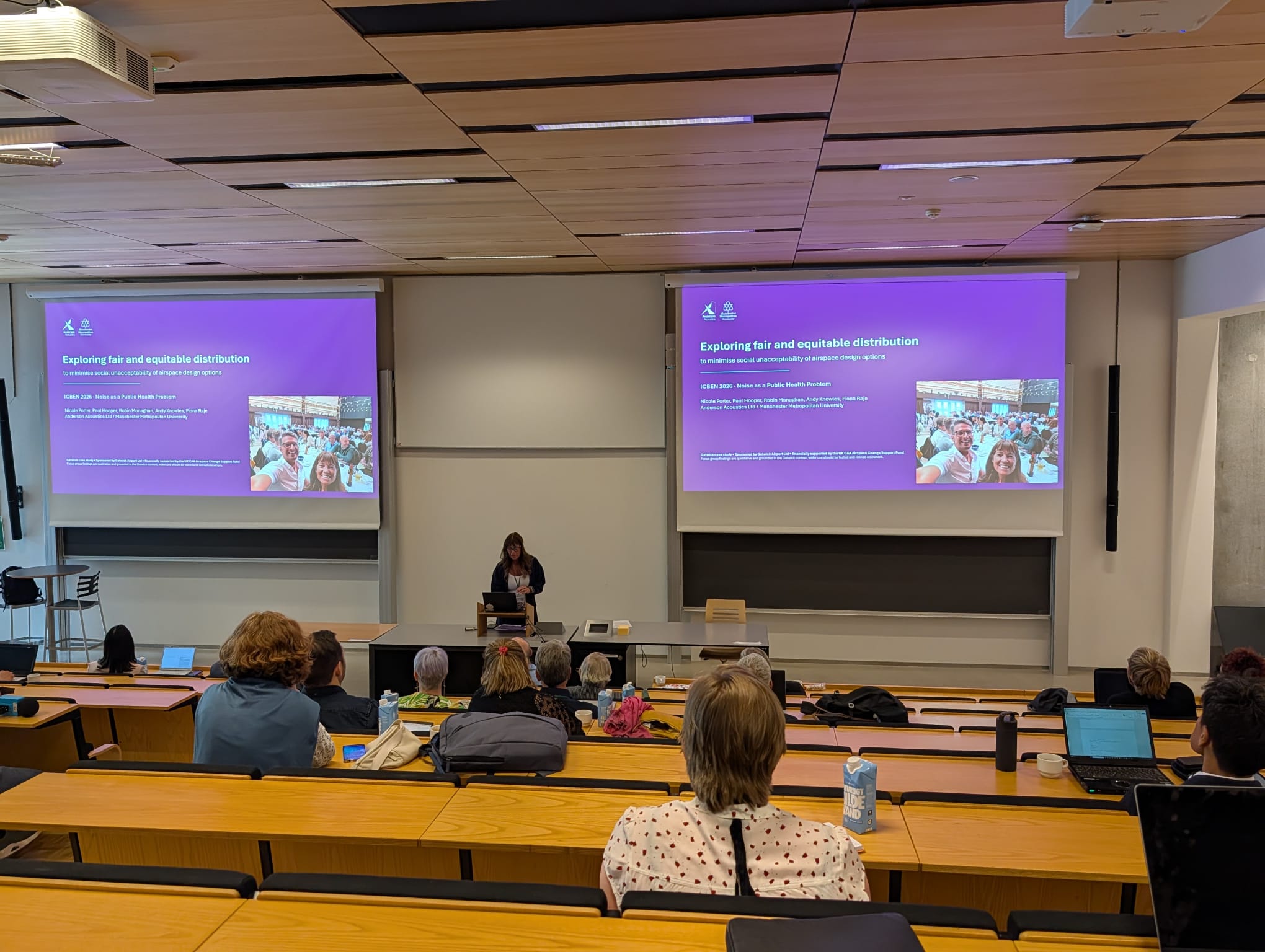
The Anderson Acoustics FED2 paper presented a Gatwick-focused case study of fair and equitable distribution of aircraft noise. The work was carried out around Gatwick, sponsored by Gatwick Airport Ltd and financially supported by the CAA Airspace Change Support Fund. The findings should therefore be understood as specific to the Gatwick context, although the issues raised are relevant to wider airspace-change practice.
FED2 asked how different airspace design features affect perceptions of fairness and equity, and how risks of socially unacceptable outcomes can be made more visible. The study used focus groups and a virtual airport to explore different design features including concentration, limited sharing, wider sharing and a new route. The use of a virtual airport allowed participants to consider principles of distribution without being anchored only to existing local positions.
A central insight was that fairness is not the same as equal sharing. Participants considered baseline exposure, the scale of change, newly overflown communities, whether already affected communities should receive relief, the predictability and transparency of arrangements, and whether respite or sharing felt meaningful. This links directly with the NAF symposium: perceived fairness is not simply an engagement issue after the modelling is complete; it is part of how communities interpret and respond to airspace options.
Overall conclusion
ICBEN 2026 showed that environmental-noise practice is moving towards a more integrated public-health approach. The conference as a whole was much broader than aircraft noise, covering many sources, settings, methods and outcomes. However, the themes most relevant to airport-noise work were strongly connected: human response, sleep, annoyance, quality of life, event-based metrics, non-acoustic factors, disability weights, social survey methods and policy translation.
Our FED2 paper sits within that broader shift. It takes the tools of aircraft-noise assessment – metrics, scenarios, route options and population exposure – and asks how those tools can better reflect fairness, social acceptability and lived experience. The conference reinforced the importance of that question. Technical assessment remains essential, but fair and effective airport-noise policy also requires understanding how communities interpret change, whether they trust the process, and whether the distribution of noise is seen as legitimate.
The strongest overall conclusion is that the future of noise assessment is not less measurement, but better-contextualised measurement. Acoustic indicators, health evidence, social survey data, NAFs and engagement evidence need to be brought together so that decisions are technically robust, policy-relevant and socially intelligible.


