
What the updated road traffic emissions tool may mean for your project
Defra has released version 15 of the Emissions Factors Toolkit, known as EFT. Air quality consultants use the EFT to calculate road traffic emissions for most UK planning assessments. The update does not introduce new air quality limits and does not automatically make an existing assessment invalid. It changes the projected vehicle fleet used in future year calculations, so some live projects may need a proportionate check or rerun. [1, 2]
For most projects, the practical effect should be limited. The greatest potential impact is on assessments that have already been modelled but not yet submitted, or where the planning conclusion is close to an air quality threshold, habitat screening criterion or significance boundary.
What has changed
The main update is to the future vehicle mix assumed outside London. EFT v15 uses more recent national projections for petrol, diesel and electric cars and vans, vehicle activity and traffic growth. It also updates supporting calculations for primary nitrogen dioxide and transport carbon emissions.
The latest forecast is not automatically cleaner than the previous one. For example, one default 2026 urban fleet in England assumes a lower proportion of electric cars under v15 than under v14.2. Depending on the project year and traffic mix, predicted emissions could increase or decrease. The effect therefore needs to be checked rather than assumed.
The main fleet change applies outside London. London projects should still record the EFT version used because v15 also updates other supporting calculations.
What it may mean for your project
Long term assessments need additional care. EFT v15 provides emission rates to 2050, but several supporting national tools extend only to 2040. Results after 2040 should therefore be treated as scenarios and may require additional assumptions or sensitivity work. [2]
Projects affecting designated habitats may also need a specific check. Natural England’s current STAIR screening tool uses emissions information derived from EFT v14.1. This does not invalidate STAIR, but a marginal result may justify a v15 sensitivity or discussion with the competent authority. [3, 4]
Possible cost and programme effects
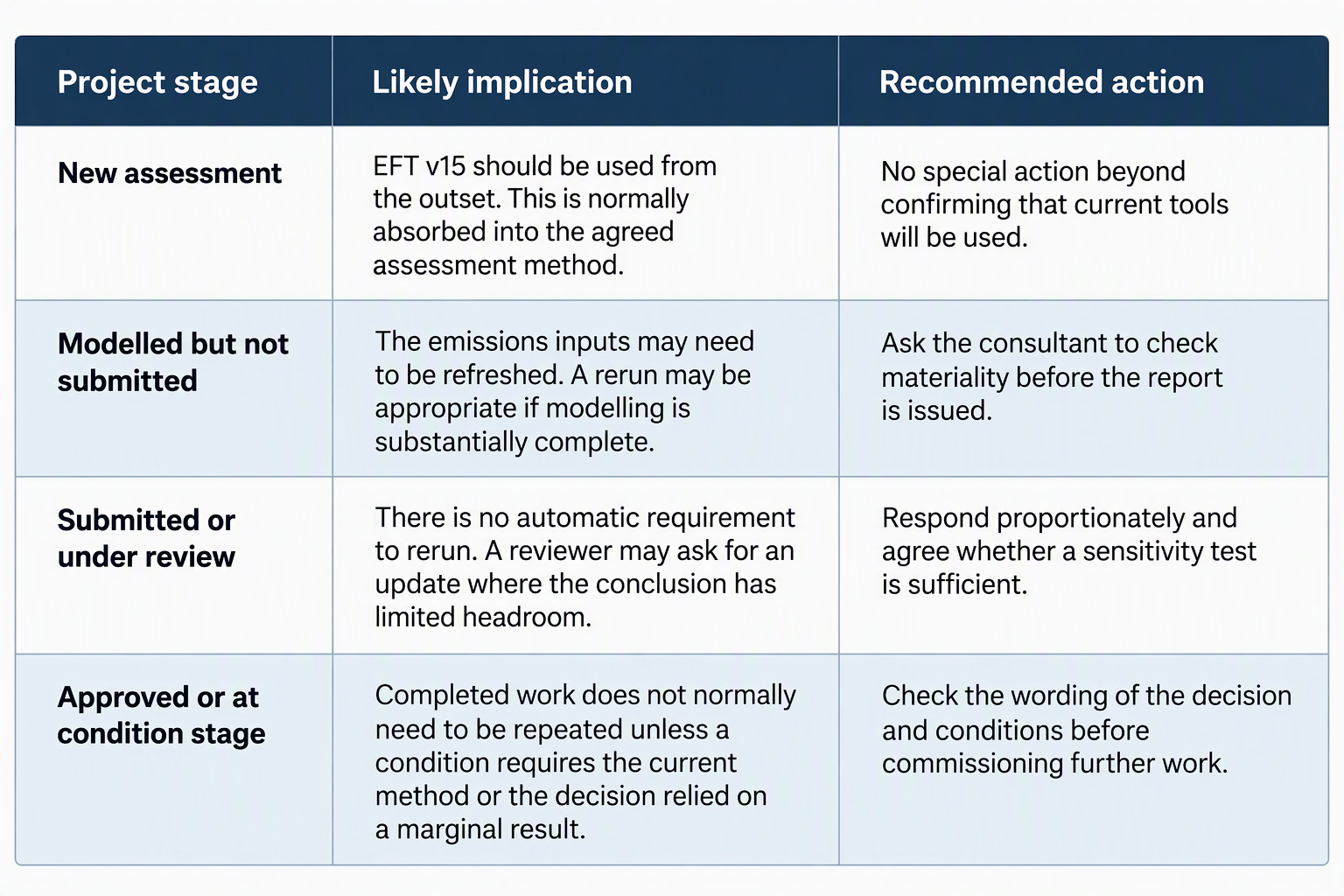
For new commissions, the update should have little or no effect on the agreed programme because v15 will be used from the start. For live work, the effect depends on how far the assessment has progressed. Updating emissions and rerunning an established model is usually more limited than rebuilding the assessment, but it still requires technical checks, updated reporting and quality assurance. Where this falls outside the original scope, an additional fee may apply and should be agreed before work starts.
Further work is most likely where a project is close to a relevant threshold, relies on a future fleet assumption that has changed materially, or is already in technical review. If the revised result changes the planning conclusion, further design, mitigation or engagement with the planning authority may be required. This should be established through a materiality check before a blanket rerun is commissioned.
What clients should do now
- Confirm which EFT version has been used on live air quality work, particularly where submission is imminent;
- Allow a short update check where modelling was completed under EFT v14.1 or v14.2 but the report has not been finalised;
- Ask for a materiality review before commissioning a full rerun of submitted or approved work;
- Retain the traffic data, assessment year and model files used for the original assessment so any comparison can be completed efficiently;
- For post 2040 or habitat sensitive projects, agree the treatment of the updated fleet assumptions with the consultant at scope stage.
What the update does not mean
- It does not create a new legal air quality limit or planning threshold;
- It does not mean every existing assessment is obsolete;
- It does not mean emissions will always increase or always decrease;
- It does not require completed work to be rerun without considering whether the conclusion could change.
Our recommended approach
We recommend using EFT v15 for all new road traffic assessments. For live or submitted work, we would first review the project stage, the version already used and the headroom in the assessment conclusion. We would then advise whether no action, a focused sensitivity test or a full update is justified, and agree any additional work before proceeding.
This avoids unnecessary reruns while ensuring that planning decisions and technical reviews rely on current evidence where the update could be material.
Sources and further reading
[1] Defra LAQM Emissions Factors Toolkit
[2] EFT v15 user guide
[3] IAQM and Natural England STAIR v1.2
[4] STAIR development note


