
We were pleased to be the Official Lanyard Sponsor for the Education Estates® Exhibition | Conference | Awards SEND event that took place earlier this month at the ExCel centre in London.
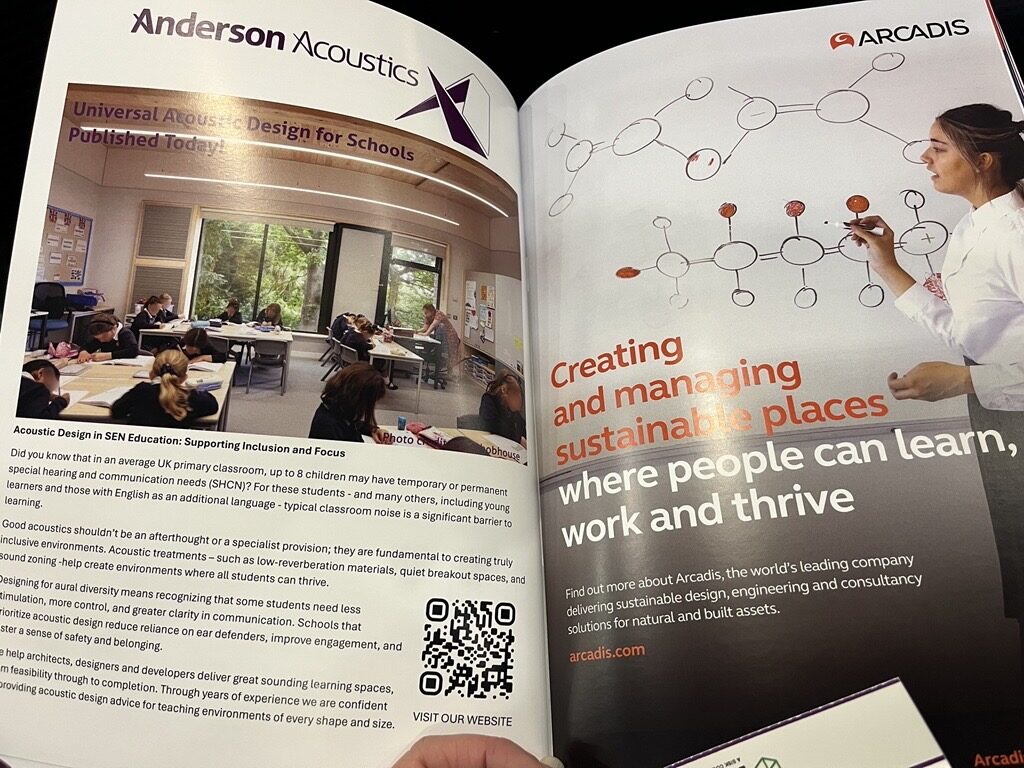
Did you know that in an average UK primary classroom, up to 8 children may have temporary or permanent special hearing and communication needs (SHCN)? For these students – and many others, including young learners and those with English as an additional language – typical classroom noise is a significant barrier to learning.
Good acoustics shouldn’t be an afterthought or a specialist provision; they are fundamental to creating truly inclusive environment.
Emma Greenland and Doushiant Mohith attended the event and enjoyed meeting up with old and new contacts discussing our work as acoustic consultants ensuring good acoustic design for all types of educational settings.

The first panel discussion was chaired by Claire Jackson with Anna Monaghan, Jo Marchant MBE, MA, MBA, FISBL and Martin Scarborough. It was great to hear Martin’s enthusiasm for the excellent acoustic conditions in the refurbishment premises at Tufnell Park Primary School, creating a calm environment throughout the school as well as the dedicated SEND base.
Highlights from the afternoon’s panel discussions included Zane Putne and Claire Barton‘s review of the Department for Education‘s CF21 Construction Framework. It was encouraging to hear the great feedback received from benefitting schools. It was interesting to hear that student dining areas are highlighted as challenging spaces.
This spotlight on the challenge of dining areas, halls and transition spaces was also flagged by Lucy Greenland in an earlier session. We need to look beyond BB93 to create calming environments in these spaces, as they represent the most uncomfortable areas for children.
Our very own Caroline McKinlay has conducted research on this topic focussing her dissertation on the acoustics of school dining halls. Her dissertation explores how reverberation time affects students’ comfort and overall experience in these spaces. Typically, discussions on school acoustics focus on classrooms due to their impact on student learning and comprehension. However, dining halls also play a crucial role in students’ social development and well-being. These spaces should support rest, connection, and recovery between lessons. Through her research, she has highlighted the importance of good acoustic design in helping achieve these goals.
Head on over to our Education sector page to learn more.


