Background
Anderson Acoustics were commissioned by the DEFRA noise policy team to undertake an extensive evidence review on the acoustic benefits of green infrastructure in urban areas. We built a collaborative team including our partners Tranquil City, Acoustic Sensor Networks and Maploom.
This was an important study, one which aligns with our values of sustainable development that works hand in hand with nature and people. Often, the benefits of green infrastructure on noise mitigation are overlooked or dismissed as ‘not significant’ enough. This investigation revealed that it does have a notable effect if considered in design, and that its psychological effect on our perception of sound provides some of the greatest benefits.
What is Green Infrastructure?
A network of multi-functional green and blue spaces and other natural features that deliver environmental, economic, health and wellbeing benefits. For this review, we considered:
- Strategic Green Infrastructure in Urban Planning;
- Green and Natural Spaces; Vegetation and Tree Belts;
- Vertical Greenery Systems (green walls and living walls);
- Green Roofs;
- Blue Spaces
Strategic Green Infrastructure includes how the quantity, access and distribution of green spaces in large urban areas is designed and how it affects inhabitants, for example, comparing a city with a handful of large parks against one with many smaller distributed green spaces.
Policy Context
The government’s 25-Year Environment Plan acknowledges that green infrastructure delivers benefits of “sequestering carbon, absorbing noise, cleansing pollutants, absorbing surface water and reducing high temperatures:” However, noise policies do not specifically mention the use of green infrastructure as a method to mitigate noise, a gap that stands in contrast to other disciplines such as air quality and biodiversity, which directly reference its benefits.
The Natural England Green Infrastructure Framework, published in early 2023, includes a chapter on Noise and Soundscapes that notes the role of trees, shrubs, green roofs and walls in reducing noise – but few references are provided to support these claims. This evidence review was commissioned to address that gap.

Our Approach
We conducted the evidence review in accordance with DEFRA’s guidance, developing the research protocol through a series of project and client meetings. This process established a conceptual model linking green infrastructure types to the acoustic effects to be investigated, along with key search terms, search portals, and agreed limitations on scope. We also incorporated search terms for wider co-benefits of green infrastructure, including air quality, carbon sequestration, urban heat island effects and flood risk mitigation.
The conceptual model addressed a range of acoustic benefits – green infrastructure not only affects the physical acoustic environment but can influence our perception of sound in significant ways. It considered:
- Reducing environmental noise;
- Improving the perception of noise;
- Introducing positive sounds and enhancing the soundscape;
- Supporting biodiversity
Our search and filtering process resulted in 214 academic studies of suitable topic and quality for review, alongside 54 reports outside of academic publications. The team applied a consistent methodology for reviewing papers, documenting key findings, flagging methodological uncertainties, and recording relevant acoustic benefits. A tiered synthesis process was then applied for each research question to provide a concise yet comprehensive findings summary.
Key Findings
- Strategic green space planning: A well-distributed plan of green spaces can reduce the significance of transportation noise exposure across a city. Strategic planning can identify locations where forestry belts can have sufficient depths and densities – one case study found £6 million in noise reduction benefits achieved with just a 3.9% increase in forestry cover;
- Ground cover: Greener ground cover types provide more noise reduction than hard landscaping, with mowed grassland providing +5 dBA in reductions and wildflower meadows providing +8 dBA;
- Forestry and tree belts: Can notably reduce noise, to the order of 6 dB for a 15m deep forest belt, but performance is highly dependent on composition and placement. The addition of lower-level shrubs can improve performance to be equivalent to a traditional noise barrier. Leaf cover provides some seasonal attenuation, with performance falling by up to 2 dBA in autumn and winter months;
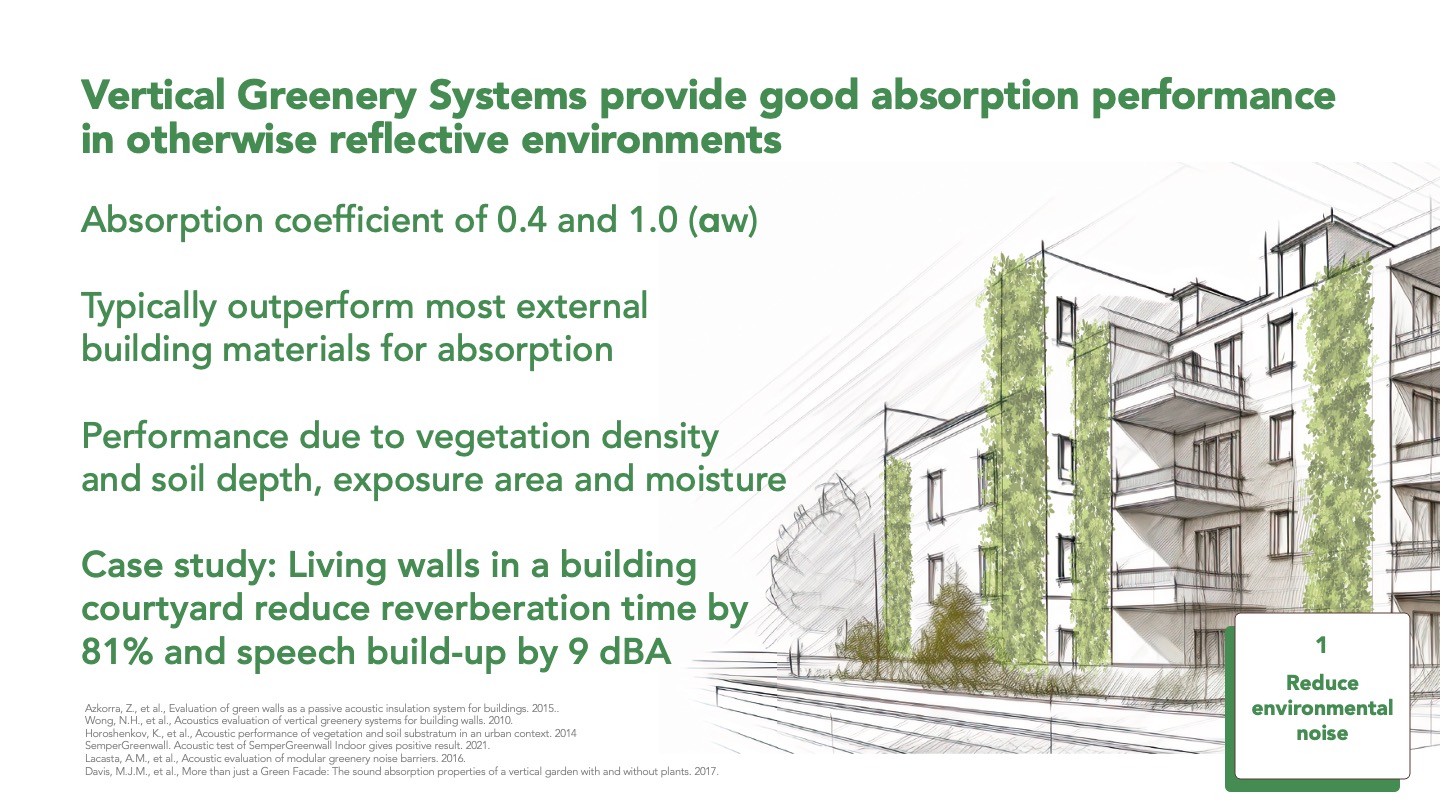
- Vertical Greenery Systems: Living walls can outperform most external building materials for sound absorption, offering 0.4 to 1.0 αw. Green walls (no soil substrate) can provide 4 dB additional reduction for solid noise barriers, while Living Walls (soil substrate) added to a façade are expected to provide an additional 15-18 dB Rw. A case study found that adding living walls to a building courtyard reduced reverberation time by 81% and speech build-up by 9 dBA;
- Green roofs: Can reduce sound diffraction over buildings, mitigating up to 10 dB at low frequencies, and provide airborne sound insulation to the order of 29-37 dB Rw;
- Psychological and perceptual effects: Views of green infrastructure can reduce the perceived level of road traffic noise by up to 10 dBA, and rail noise by up to 6 dBA. Access to green and blue spaces mediates the negative effects of noise exposure: people with more greenery nearby report lower noise sensitivity and reduced long-term noise annoyance. Introducing natural sounds – particularly birdsong and flowing water – promotes informational masking and mental restoration, increasing perceived tranquillity and neighbourhood satisfaction;
- Biodiversity: Noise exposure can reduce bird and insect populations, with effects varying by species depending on vocal frequency. Birds with higher-frequency calls are more significantly affected.

Evidence Gaps
During the review, we identified the following areas where further research is needed to support policy decisions and guidance:
- Objective sound reduction evidence is established but lacks in-situ examples;
- Subjective response and health outcomes evidence is less established, with further research needed on the role of green infrastructure quality and socio-demographic preferences;
- Long-term studies on perceived noise reduction and its link to sustained health and wellbeing outcomes;
- Biodiversity impact evidence is limited in both specie coverage and scope;
- Links between sustainable urban development and acoustic benefits remain speculative and require in-situ validation.
Industry Roundtables
Following the review, DEFRA asked us to facilitate a series of stakeholder roundtables to disseminate findings to practitioners beyond the acoustics sector, recognising that many teams’ implementing green infrastructure in urban areas do not include acousticians in their decision-making processes. Stakeholders included landscape architects, green infrastructure specialists and installers, local authorities, property developers and urban planners.
The roundtables addressed two questions: whether the level of technical detail in the report was suitable for non-acousticians, and how findings could best be disseminated to increase the number of in-situ case studies of acoustic benefit.
The conclusions were that the Executive Summary and Visual format was most suited to urban planners, policymakers and local governments – 89% of participants found it either ‘relevant’ or ‘very relevant’ to their role, and 50% felt it would be ‘easy’ or ‘very easy’ to apply the findings in their work.
Recommendations for Wider Dissemination
- Engage with professional institutes and organisations to promote cross-disciplinary collaboration;
- Incorporate acoustic considerations into existing green infrastructure policies, guidelines and assessment frameworks;
- Identify and support in-situ case studies through partnerships between industry and research;
- Develop practical design guidance and tools for professionals;
- Explore the development of software tools or models to help designers and planners optimise the placement and selection of green infrastructure for acoustic benefits;
- Explore funding opportunities and conduct further research on the long-term health and wellbeing impacts of green infrastructure’s acoustic benefits
Testimonial
“Thank you and your team for your brilliant, professional work and collaboration on this project. It has been a pleasure to co-design the work with you and see it positively pan out in the way that it did.” Luca Marazzi, DEFRA