
Background
Anderson Acoustics was commissioned by Gebler Tooth Architects (on behalf of Teesside International Airport) in August 2022 to provide a noise assessment and noise management plan to support a planning application for what is known as the Willis Aviation Village.
The project involves the construction of new facilities comprising hangars for aircraft storage and light maintenance, external works including apron extensions and modifications, a new Fixed Based Operation building or FBO (800m2 approx. over 2 floors) and the installation of external plant items.
What we did
Management controls would be required to address the potential noise impact of the 24×7 operated hangar bays. These are typically used for base maintenance and MRO (Maintenance, Repair and Overhaul) activities generally occurring behind closed doors, in an enclosed environment. Occasionally (e.g. once per week) activities include auxiliary aircraft power units (APUs) being operated for up to 30 minutes, with hangar bay doors open which could potentially lead to high levels of noise breakout to outside.
We undertook a baseline noise survey at the site to characterise existing ambient noise levels at both the nearest noise-sensitive receptors and also at the proposed MRO and FBO buildings. These measurements were then used to compare potential noise impacts from likely operations at the MRO with the current noise conditions in the area, as well as to establish plant noise limits at the nearest residential receptors to ensure the operation of the proposed scheme would not significantly affect the living conditions of nearby residents.

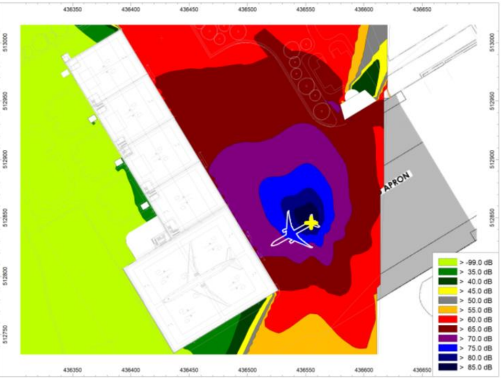
Our assessment showed that noise levels due to internal maintenance operations within the proposed hangars would have a negligible noise impact at the nearest noise sensitive receptors. This assumed hangar doors would be kept closed during all maintenance works. The same applied to any painting activities undertaken within the paint shop bay.
When assessing the impact of the aircraft power units (APUs), our assessment indicated that operational noise levels would likely have a negligible impact on typical daytime ambient sound levels, in line with IEMA guidelines.
Noise emissions from an APU may be loud locally for short periods of time, however the noise character of such events is no different to aircraft taking off, taxing or manoeuvering within the airport, and neighbouring residential receptors may not necessarily attribute these new APU operating to specific procedures that were not already considered part of the standard operation of the airport.
Therefore, when putting the predicted increase in terms of ambient noise levels into context of an existing aircraft-noise dominated environment, we advised that potential noise impacts would be low and that the operation of the proposed MRO would not significantly impact on the living conditions of the residents surrounding it.
We provided a noise management plan that outlined the management control measures that would ensure noise emissions from the proposed development be kept to a minimum.

Image source – Gebler Tooth Architects
Project Progress
The Facility received planning approval in March 2023.


