
Background
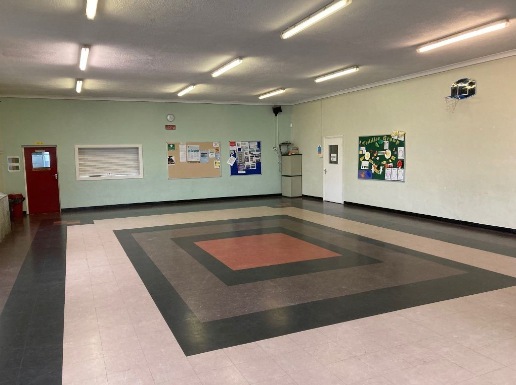
Anderson Acoustics was commissioned by Socketts Heath Baptist Church in Grays, Essex to provide room acoustic design advice for the reverberation control treatment of the existing Church Hall (The Thompson Room).
Users of the hall were experiencing problems with poor speech intelligibility, particularly during larger events involving more than 50 people.
The Hall was not currently used for formal meetings due to the poor acoustics but was the location for a range of other events such as youth clubs and activities, parent and toddler groups, food bank and sit down meals. Whilst the adjoining church was being used for other meetings and concerts, the proposed works to the Hall would improve flexibility for this use.
The Challenge
The Hall had very little fixtures and fittings in place and low ceilings, so any acoustic treatment would need to consider these design constraints.
What we did
Acoustic Capacity
Multiple people speaking in a room can create a high noise level, due to the phenomenon when the ambient noise from the other people speaking means that everyone raises their voice, leading in turn to a spiralling ambient noise level (known as the Lombard Effect).
The ‘Acoustic Capacity’ of a space is defined as the maximum number of people in order to avoid insufficient quality of verbal communication for casual social conversation. For the multi-purpose Hall with low ceilings, it was important to set acoustic performance targets for the different group activities whilst being able to maximise acoustic capacity.
The existing space did not have dedicated sound absorbent finishes applied already which would be affecting the reverberation time – the time required for the sound to ‘fade away’ or decay in a closed space. Coupled with a low ceiling height which limits the room volume, even moderately reverberant spaces can result in a build-up in occupied noise levels and cause poor speech clarity and intelligibility. This leads to an uncomfortable listening environment and poor communication for all users, but particularly those with special hearing and listening needs. Reverberation time can be controlled by the installation of sound absorbent treatments in strategic locations.

We undertook an assessment of the reverberation time based on the room dimensions and existing surface finishes. The results of this assessment then allowed us to establish target reverberation time criteria for the space to improve acoustic capacity.
Acoustic Treatments
Recommendations were made for sound absorbent treatments to suitably control reverberation time, within the existing design constraints. We provided a technical note to inform the acoustic brief for the contractor to then develop the design.
Testimonial
Andrew Wade, Church Secretary comments “Our story is that we knew we had a problem but no expertise to solve it. We commissioned Emma Greenland from Anderson Acoustics to carry out a report and study on the hall and used this as a basis to get quotes from a number of companies. Emma recommended four suppliers to us and we approached them. We chose to go with Sound Reduction Systems. The room is now useable again and everyone keeps commenting how quiet is it. We are really pleased and the hall has a whole new life with everyone wanting to use it!


